Introduction to Modern Quantum Error Control Systems
S-NISQ Quantum Error Correction computing operates in an environment where tiny disturbances can completely change results. Intermediate-scale quantum processors are especially vulnerable because they contain limited qubit counts and high noise levels. This creates a strong need for advanced correction techniques that stabilize computation and preserve data accuracy during processing.
Modern approaches focus on reducing computational instability by identifying and correcting errors before they spread through quantum circuits. These systems are essential because they allow quantum devices to perform longer calculations with improved reliability, bringing practical quantum applications closer to reality.
Structure and Behavior of Intermediate-Scale Quantum Systems
Intermediate-scale quantum machines operate between experimental prototypes and fully scalable quantum computers. They are powerful but still heavily influenced by environmental noise, temperature fluctuations, and hardware imperfections that reduce performance accuracy.
The architecture of these systems relies on delicate qubit interactions, where even minor disturbances can cause decoherence. Engineers design hardware layouts to minimize interference while improving gate precision, ensuring that computational processes remain as stable as possible under physical constraints.
Core Mechanisms of Quantum Error Handling
Quantum error handling is based on detecting disruptions without directly measuring the quantum state. This is necessary because direct measurement collapses quantum information, making traditional correction methods unusable.
To solve this, redundancy is introduced through entangled qubit structures that encode logical information across multiple physical units. This allows systems to detect inconsistencies and restore correct states without destroying the original computational data.
Advanced Techniques for Noise Reduction in Quantum Systems
Several advanced strategies are used to manage noise in intermediate quantum processors. Stabilizer-based coding techniques help identify error patterns, while surface-based encoding structures distribute information across larger qubit networks for increased protection.
Another important approach involves hybrid correction strategies that combine classical computation with quantum operations. These hybrid systems analyze noise behavior and adjust operations dynamically to maintain computational accuracy throughout execution.
Limitations and Technical Challenges in Quantum Stability
One of the biggest challenges in quantum computing is the high resource cost of implementing full correction systems. Many methods require additional qubits, which are limited in intermediate-scale devices, creating a trade-off between accuracy and efficiency.
Another major issue is inconsistent noise behavior across different quantum hardware platforms. Because each system behaves differently, designing universal correction strategies becomes extremely complex and often requires customization for each architecture.
Emerging Innovations in Quantum Stability Research
Recent progress in this field includes the use of machine learning models to predict and correct quantum errors in real time. These systems analyze patterns in noise and adjust correction strategies dynamically to improve overall system reliability.
Experimental research in superconducting and trapped-ion platforms has also shown improvements in coherence stability. These advancements demonstrate steady progress toward more practical and scalable quantum computing systems.
Real-World Applications of Quantum Stability Methods
Error correction techniques are essential in areas requiring high computational precision. In quantum chemistry, they help simulate molecular structures with greater accuracy, enabling breakthroughs in material science and drug discovery.
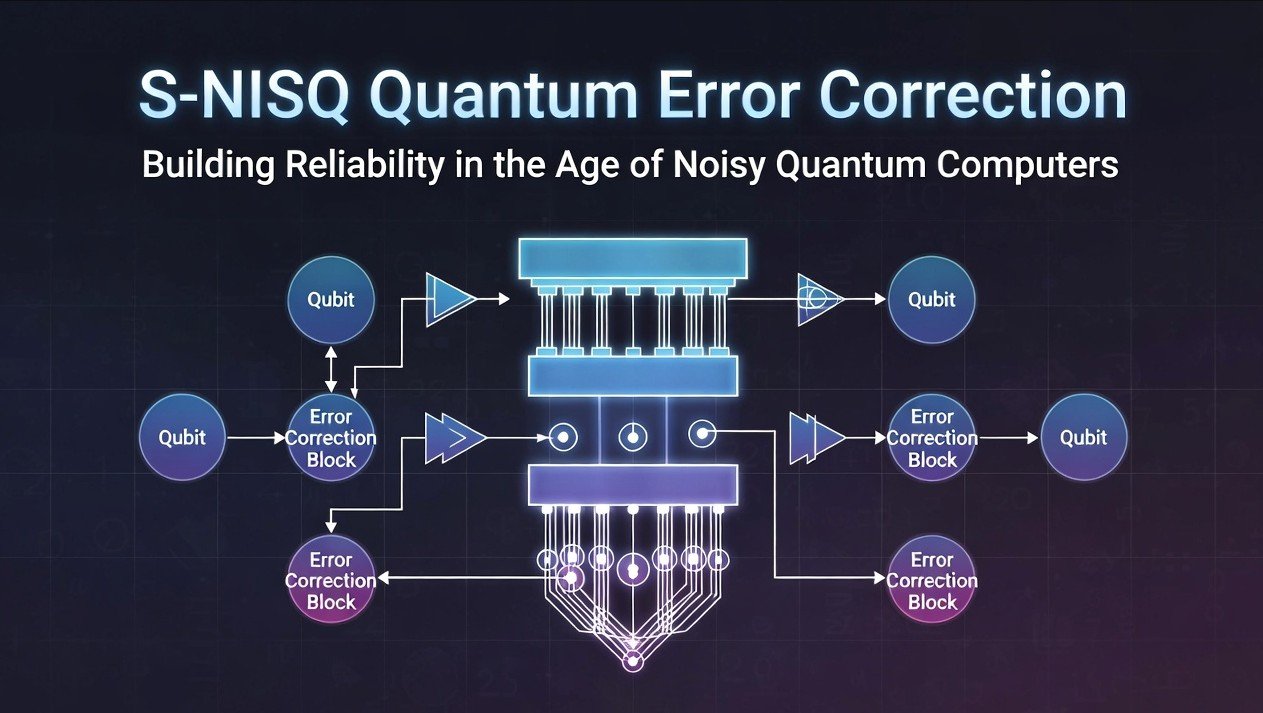
In optimization and finance, these S-NISQ Quantum Error Correction improve the reliability of complex calculations involving large datasets. They also contribute to cryptography and artificial intelligence, where stable quantum computations can significantly enhance performance.
Future Direction of Quantum Computing Stability
The future of quantum computing depends heavily on improving correction efficiency while reducing hardware overhead. Researchers are working toward systems that require fewer additional qubits while maintaining high accuracy levels.
As technology evolves, more scalable and practical solutions are expected to emerge. These improvements will gradually transition intermediate quantum systems into fully fault-tolerant machines capable of solving problems beyond classical computing limits.
Conclusion
Quantum error control systems are a critical foundation for the progress of modern quantum computing. They ensure that fragile quantum states remain stable long enough to perform meaningful calculations in noisy environments.
Ongoing research continues to push the boundaries of what is possible, making future quantum devices more reliable, scalable, and applicable across scientific and industrial domains.
FAQs
What is the purpose of quantum error correction?
It is used to detect and fix errors in quantum systems caused by noise and instability.
Why are intermediate-scale quantum devices challenging?
They have limited qubits and high sensitivity to environmental disturbances.
How is quantum information protected?
It is distributed across multiple entangled qubits to prevent data loss from errors.
What are the main difficulties in this field?
Major challenges include resource limitations and unpredictable noise behavior.
Where can these techniques be applied?
They are used in chemistry, finance, AI, optimization, and cryptography.